Power Shake-Up in Senegal as President Faye Sacks PM Sonko Amid Debt Crisis

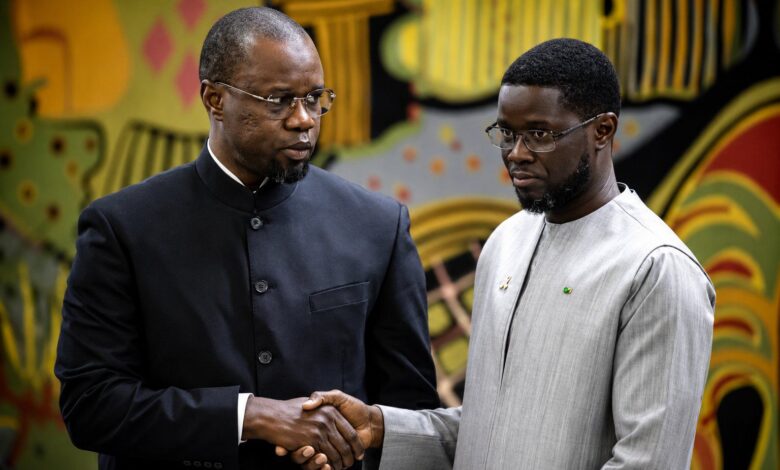
Senegal’s political landscape took a dramatic turn on Friday after President Bassirou Diomaye Faye dismissed Prime Minister Ousmane Sonko and dissolved the entire government. The decision has triggered fresh uncertainty in a country already dealing with economic pressure and sensitive negotiations with the International Monetary Fund.
The announcement, delivered through a statement read on state media, confirmed that all ministers had been relieved of their duties. However, the outgoing cabinet will remain in place temporarily to handle day-to-day government operations as the country navigates the transition.
The move marks a sharp break between two leaders who once stood side by side during Senegal’s recent political transformation. Their partnership had been seen as central to the country’s reform agenda after the 2024 elections.
From Political Allies to Rivals in Power
Faye and Sonko’s fallout has been building for months, quietly reshaping Senegal’s political direction behind the scenes. The two men were once united by a shared opposition movement that challenged the previous administration.
Sonko, a popular and outspoken political figure with strong youth support, played a key role in backing Faye’s successful 2024 presidential campaign. He had been barred from contesting the election himself following a defamation conviction, but remained a powerful force in the political landscape.
After winning the presidency, Faye appointed Sonko as prime minister, cementing what many believed was a long-term alliance. However, growing disagreements over policy direction and governance appear to have strained that relationship beyond repair.
Economic Pressure and IMF Deadlock
The political shake-up comes at a time when Senegal is facing serious economic headwinds. The International Monetary Fund recently froze a $1.8 billion lending programme after irregularities were discovered in the country’s debt reporting.
That discovery pushed Senegal’s debt level to an estimated 132% of its economic output, raising concerns about fiscal stability and long-term recovery prospects. The freeze has complicated efforts to stabilise public finances and restore investor confidence.
Officials have warned that delays in negotiations with the IMF could slow down critical reforms needed to unlock funding and support economic recovery. The timing of the political crisis now adds another layer of uncertainty.
Behind the scenes, disagreements between Faye and Sonko reportedly deepened over how to handle debt restructuring and energy policy.
Finance Minister Cheikh Diba had earlier told parliament that Senegal hoped to resume talks with the IMF in early June, with a possible agreement expected by the end of the month. However, policy divisions within the leadership appeared to complicate that roadmap.
One of the key sticking points has been fuel subsidies and energy pricing. Projections suggest the fuel subsidy bill could exceed expectations by as much as 1.15 trillion CFA francs if global oil prices rise sharply.
Sonko had opposed raising fuel prices and also resisted debt restructuring proposals linked to IMF discussions, setting him on a collision course with economic policymakers.
The political split between Faye and Sonko has roots stretching back to their rise as opposition figures under former President Macky Sall. Both men were jailed ahead of the 2024 elections amid political unrest that shook the country.
Their release just days before the vote reshaped the political atmosphere, with Faye eventually winning the presidency with 54% of the vote. At that point, their partnership appeared to signal a new era for Senegal.
However, tensions began surfacing earlier this year as Sonko hinted he could withdraw his party from government if he believed the administration was drifting away from their shared agenda.
With his removal from office, questions are now emerging over Ousmane Sonko’s next political move. His influence within the opposition remains strong, and his party holds significant power in the National Assembly.
This parliamentary strength could create challenges for President Faye as he seeks to push through reforms required for IMF support and economic stabilisation. Governance may now depend on fragile political negotiations.
Sonko has previously suggested a return to opposition politics was possible if disagreements with the presidency became irreconcilable, raising speculation that the latest developments may push him further in that direction.
Senegal now finds itself at a crossroads, where political rivalry and economic pressure are colliding at a critical moment. The dismissal of Ousmane Sonko signals a major shift in the country’s leadership structure, with potential consequences for both governance and international financial negotiations.
As the government continues in a caretaker capacity, attention will turn to how quickly President Faye can stabilise the political environment and revive stalled IMF talks. The coming weeks are likely to shape Senegal’s economic and political direction for years ahead.